
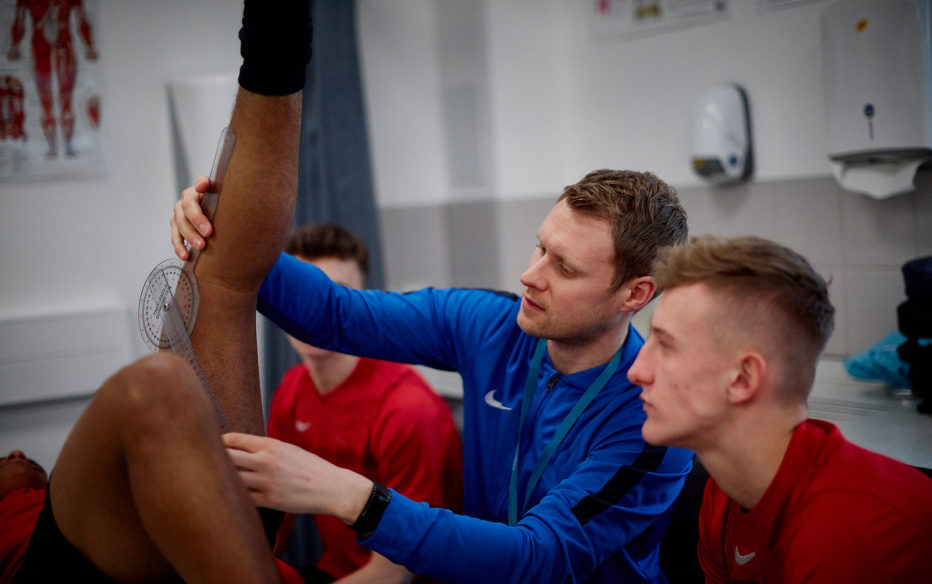
Elevate your passion for sports into a rewarding career by mastering the essential skills and knowledge required for excellence in coaching and performance. Develop the skills and knowledge needed to excel in sports coaching and performance with a course designed to prepare you for a career in this dynamic field.
Combining practical experience with academic insight, the course covers key topics such as coaching techniques, performance analysis, and the science behind physical activity. Practical placements, including opportunities within the community, provide real-world experience and the chance to build a professional network. With a focus on personal development, this course equips you with the expertise to inspire and lead at all levels, from grassroots to elite sports.
Academic entry requirements are as follows:
Level 4 - 48 UCAS tariff points
Level 5 - Pass and proceed from Level 4
Applicants who do not have the recognised UCAS tariff points will be considered on a case by case basis.
It is mandatory that students enrolling on this course are able to go through a Disclosure and Barring Service (DBS) check, as a requirement of this programme is to actively work with members of the community.
Here’s how to apply depending on your plans:
• If this College is your only choice, you can begin the process by selecting the “Apply” button at the top of this course page, which will take you to the online application form for a simple and direct experience.
• If you’re applying to multiple Higher Education providers, submit your application through the Universities and Colleges Admissions Service (UCAS) by the specified deadline for the relevant recruitment cycle. This ensures your application reaches all your chosen institutions efficiently.
• For detailed information on UCAS applications and deadlines, https://www.ucas.com/applying .
| Study level | Cost | Additional fees |
|---|---|---|
| HE | Please enquire | Course Fee: £6,355.00 *Please note that all fees are subject to change and will be confirmed upon enrolment.* Further information about financial support can be found on our page here: https://sunderlandcollege.ac.uk/experience/financial-support/higher-education-financial-support/ Students will be expected to purchase a uniform (Prices TBC). Students must apply for a Disclosure and Barring Service Enhanced check. Membership with the Chartered Institute for the Management of Sport and Physical Activity (CIMPSA) membership would be necessary too. |
Fundamentals of Anatomy and Biomechanics
Multiple Choice Quiz (MCQ)
Presentation (10minutes)
Preparation for Learning in Sport, Health, and Exercise
Report (2000 words)
Innovative Presentation
Introduction to Coaching Pedagogy
Podcast (Audio recording)
Infographic
Introduction to Sport and Exercise Psychology
Poster
Report
Introduction to Human Physiology and Performance
Presentation
Booklet
Nutrition for Sport, Health and Exercise
Infographic
Short Documentary
Applicants are ideally expected to hold GCSE English Language and Mathematics at grade 4/C or above, or a Level 2 equivalent qualification. These qualifications support the development of the literacy and numeracy skills needed to succeed in higher education and within your chosen career.
Work placement is a mandatory part of this course, providing a strong foundation for developing practical skills and professional confidence. You will be supported in securing a placement, with established partnerships including Foundation of Light and a number of local schools, including those within the Farringdon Schools Partnership.
It will be expected that students take part in placements in year 2 of the Foundation Degree. During this time, you will complete smaller placements across both sports coaching and performance analysis, allowing you to gain a broad range of experience within the sector.
These opportunities enable you to apply your learning in real working environments, develop industry relevant skills, and build valuable professional connections to support your future career progression.
We partner with a diverse range of organisations, including RISE – the Active Partnership for Tyne, Wear, and Northumberland, as well as UK Coaching, County Durham FA, Everyone Active, and the Foundation of Light. These connections provide valuable industry insights and networking opportunities.
At Sunderland College, students can also benefit from our range of sporting academies, including football, rugby, basketball, netball, and the Talented Athlete Scholarship Scheme (TASS).
Throughout the course, students will engage in talks and seminars led by expert guest speakers, go on exciting trips, and gain hands-on experience through industry-focused modules. This qualification offers unique opportunities to enhance employability, such as:
First aid certification
Level 2 national governing body qualification
Gym instructor qualification
Optional NPLQ lifeguard qualification
Optional swim teacher certification
These experiences ensure students are well-prepared for a successful career in the sports industry.
It is expected that students attend all timetabled activity. Scheduled learning and teaching activities with account for approximately 30% of the student's time associated with each module, and approximately 70% will be expected to be guided independent study including online.
The Foundation Degree in Sports Coaching and Performance enables students to learn about a range of topics, including:
- Managing scientific information
- Collaborating with others
- Becoming reflective practitioners
- Innovation and creativity
- Effective communication
- Working independently
This programme will allow you to gain Levels 4 and 5, resulting in the opportunity to progress internally onto the BSc (Honours) in Sports Coaching and Performance - Top up course.
We also ensure our students leave as qualified sports coaches.
You will have the opportunity to attend an international trip where students can experience sporting culture in a another country.
You will study modules including:
Level 4 (Total of 120 credits):
Fundamentals of Anatomy and Biomechanics (20 credits) -
The difference between winning and losing in professional sports are attributed to fine margins. Sports coaches and professionals alike, equip staff with expertise to gain those advantages to be successful. The module aims to develop the students understanding of the importance the musculoskeletal system contributes to optimal sports performance. Students will have the opportunity to explore the interconnections of the locomotor system that allows the human body to produce efficient and coordinated movement patterns. This will be explored further through biomechanics and motion analysis. This module links with introduction to human physiology and performance and introduction to performance analysis.
Preparation for Learning in Sport, Health and Exercise (20 credits) -
Students will learn about the skills for success first as this is very important for each student to understand what is expected of them as Higher Education students. They will learn the processes and skills involved in being able to achieve success as an undergraduate student on this programme. Students will then learn about reflective practice and how they should be evaluating their performances and being analytical and critical. It is important that students are able to successfully plan and map out their personal and professional pathway; including the skills, knowledge and experience that is required for them. And lastly, the inclusion of innovation and entrepreneurship is important to help students understand that they have the opportunity to set up their own businesses and discover the innovative process surrounding a start up.
Introduction to Coaching Pedagogy (20 credits) -
The module aims to develop the students understanding of the various roles a coach requires. Students will begin to understand all the key roles and responsibilities which are necessary for sports coaches. The module gives an insight into the different leadership styles and how these are relevant for modern-day coaching. The module aims to use models of leadership styles and challenge students on how these styles can be incorporated into other models, such as Chelladurai’s Multidimensional Model of Leadership. The module intends to cover a number of different theories around how people learn, and students will learn why this is important to understand from a coaching perspective. The module aims to explore the factors which can impact on learning and how important creating a positive coaching and learning environment is for the participant’s development. This module links with the Introduction to Sport and Exercise Psychology, the Fundamentals of Anatomy and Biomechanics and the Preparation for Learning in Sport, Health, and Exercise.
Introduction to Sport and Exercise Psychology (20 credits) -
This module acts as an introduction to psychology within sport and exercise. Students will be introduced to 2 major psychological factors (Motivation and Self-Confidence) that fall within this topic and some of theories associated with them. This module will provide a firm base for future modules and pathways in sports psychology (Levels 5 and 6). Group processes and leadership has also been included in this introductory module as it will link with the Introduction to Coaching Pedagogy module, and is important for student progression as sports coaches.
Introduction to Human Physiology and Performance (20 credits) -
The human body is physically capable of such great sporting feats. The module aims to explore and introduce underpinning knowledge of human physiology and performance. Understanding how the cardiorespiratory, neural, and endocrine systems interrelate is essential for sport and performance. This module will also address physiological factors in the form of cellular and metabolic processes and students will be involved in putting theory to practice through investigative lab-based testing techniques, this will allow students to consider how different parameters may be measured, analysed, and applied within sporting performances. This module will appeal to students who are interested in careers pathways in athlete development, such as strength and conditioning coaches or performance coaches. This module links to the units Fundamentals of Anatomy and Biomechanics and Introduction to Performance Analysis.
Nutrition for Sport, Health and Exercise (20 credits) -
The significant role of nutrition cannot be underestimated. Nutrition is important for the maintenance of health regardless of an individual being an athlete or not. Nutrition and lifestyle factors are a key performance indicator for optimum performance in sport, health, and exercise. This module aims to underpin the importance nutrition contributes to both elite and recreational populations and equip students with knowledge, skills, and competencies to understand the nutritional composition of food and the effects of nutritional choices on the health of a person.
Level 5:
Introduction to Strength and Conditioning (20 credits) -
This module aims to provide students with a sound understanding of the fundamental roles that need to be fulfilled by a strength and conditioning coach in practice. This includes the ability to select appropriate testing methods based on an understanding of human movement and sport specificity, the practical ability and movement competence to demonstrate and coach key strength and conditioning techniques, and the ability to select and programme these exercises in order to achieve desired outcomes.
Social Psychology for Sport and Exercise (20 credits) -
This module differs from the ‘Introduction to Sport and Exercise Psychology’ module taught at Level 4 as it builds upon the psychological factors of motivation and self-confidence and has more of an emphasis on the social influences on mindset. This indicative content will help learners understand the participant behaviours that may occur when they are coaching. Students will be able to explore various modules of exercise behaviour and behaviour change that may be useful to help promote positive behaviours of participants they’re working with and help to break down barriers to participant to maximise inclusion and engagement. The tools learnt within this module could help to increase the levels of uptake in sport and exercise and develop people’s health and wellbeing.
The Reflective Sports Coach (20 credits) -
This module will not only give the students an opportunity to undertake practical coaching, but also an opportunity to use the reflective models within their own practice. The students are being asked to log their hours which will help them to be frequent with their logging which is something full-time coaches will need to record. The students will benefit from taking part in meaningful sports coaching placement here. Students have the option of finding their own placement, or can gain support from lecturers to help engage with schools/clubs etc.
Sports Development and Performance Pathways (20 credits) -
The purpose of this module is for students to learn and understand the importance of sports development. They’ll learn about historical events that’ve impacted on sports participation within the UK, as well as the strategies by different sporting National Governing Bodies to promote inclusion and involvement, and how performers can progress up the Sports Development Continuum within their sport. Students will also learn about sports development initiatives that have been created by various organisations, each with different aims and objectives.
Introduction to Performance Analysis (20 credits) -
Analysis of sporting performance has progressed rapidly with evolving technology. This unit aims to give learners underpinning knowledge and skills to undertake, capture and analyse a sporting performance. Students will gain an insight into the different requirements in individual and team sports, including skills, techniques, tactics, fitness, physiological and psychological elements, and how different methods of assessment can be used for different areas of performance.
Research Methods – Coaching Project (20 credits) -
The purpose of this module is to enhance the research-skills of the students. The students will be able to identify an area of focus which interests them and apply learnt research skills to propose a research project. This module will prepare learners for the following year when the students’ progress onto the BSc (Hons) in Sports Coaching and Performance where they will complete a major independent study through a Dissertation. Students will utilise skills learn in previous modules (Preparation for Learning in Sport, Health and Exercise at Level 4) and further advance them using skills learnt in this module.
Level 4 - 120 credits
Level 5 - 120 credits
Total - 240 credits
Completing this course opens doors to a range of exciting opportunities. Students can progress to a full honours degree BSc (Honours) Sports Coaching and Performance Top Up qualification (Level 6), specialising further in coaching, performance, or sports science. Career prospects include roles such as professional sports coach, performance analyst, fitness instructor, or development officer, with pathways into elite sports, community programmes, and education.
The skills gained also provide a strong foundation for entrepreneurial ventures in the sports and fitness industry. Whether advancing in higher education or stepping directly into employment, graduates are well-equipped to thrive in a rewarding field that combines their passion for sport with professional expertise.
This is a Higher Education course awarded by the University of Hull.
To visit the University of Hull website, click here.

Find out everything you need to know about Sunderland College and our exciting range of courses!
Register for our next open event

Rated Outstanding in all areas by Ofsted
Ofsted, 2024

94% Overall pass rate for T Levels
2022-23

Top performing college group in the North East for student achievement
NARTS, 16-18 Students, 2024

We have International award winning Immersive Spaces at both Bede and City Campus