
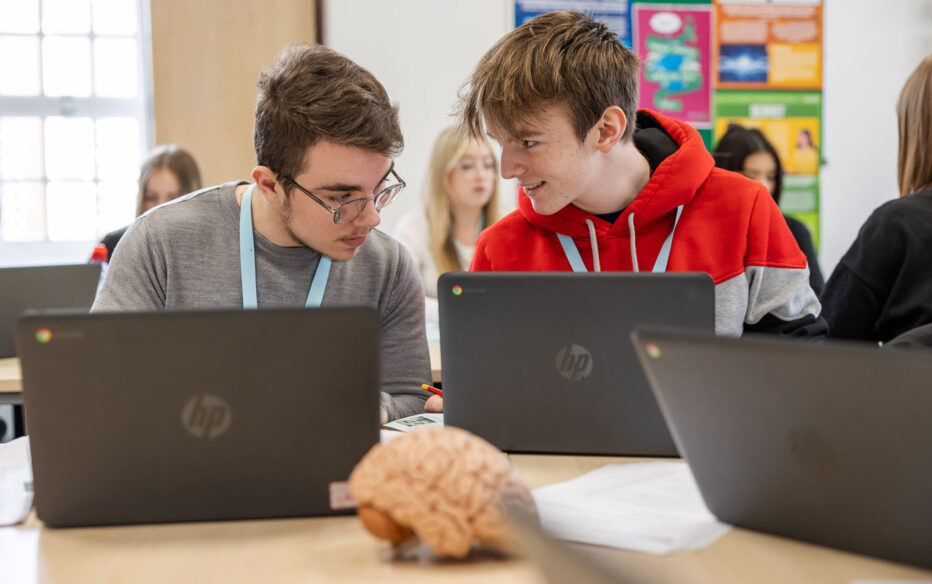
Psychology delves into the scientific study of behaviour and experience, exploring the intricacies of thoughts, feelings, and actions. Recognised as a STEM subject, this course integrates elements of biology and mathematics, providing a comprehensive understanding of human behaviour. In the first year, students engage with both classic and contemporary research, examining topics such as the origins of phobias, the neurological underpinnings of self-control, observational learning of aggression, adult autism identification, the effects of hemispheric disconnection, and the psychology behind obedience to authority.
The second year shifts focus to mental health, exploring its causes, diagnostic criteria, and treatment options. Additionally, students delve into criminal psychology, investigating crime causation, forensic evidence handling, and crime prevention strategies. The course also covers child development, offering insights into the adolescent brain, perceptual growth in infants, attachment theories, and gender stereotyping. This curriculum is designed for those passionate about understanding the human mind and pursuing a career in psychology.
You will need 5 GCSE's at grade 5-9, including English Language and Science, as well as Maths at a grade 6.
| Study level | Cost | Additional fees |
|---|---|---|
| 16-18 | Free | You will need to provide your own stationery, including a calculator and ruler which are needed on the course, and you will be given the opportunity to take part in trips and visits. You may want to purchase the Edexcel student book or revision guide for A Level Psychology |
The Pearson Edexcel A Level Psychology qualification is assessed through three externally examined papers. Students complete all assessments at the end of Year 13.
1. Paper 1: Foundations in Psychology — 35% of the A Level
• Written examination
• 2 hours 15 minutes
• 90 marks
• Covers Social Psychology, Cognitive Psychology, Biological Psychology, Learning Theories, and Issues and Debates
2. Paper 2: Applications of Psychology — 35% of the A Level
• Written examination
• 2 hours 15 minutes
• 90 marks
• Covers Clinical Psychology and Child Psychology
3. Paper 3: Psychological Skills — 30% of the A Level
• Written examination
• 2 hours
• 80 marks
• Covers research methods, classic studies, synoptic links, mathematical skills, statistical testing, and Issues and Debates
Students will also complete regular in-class assessments, timed essays, exam-style questions, research methods tasks and data interpretation practice throughout the course to prepare for the final examinations.
English and maths are important life skills that will help you to achieve your best in your studies and progress to your dream career. If you have not already achieved grade 9-4 in GCSE maths and/ or English at school, we will support you to improve your skills.
Our A Level programmes allow you to choose multiple subjects, enabling you to study 3–4 A Levels over two years or combine them with equivalent vocational qualifications, with each subject taught for 4 hours and 30 minutes per week across three separate lessons and your timetable determined by your chosen subjects (provided at the start of the academic year).
Although you are not required to be on campus when you do not have a timetabled lesson, we strongly recommend making effective use of our learning facilities and resources during these periods to stay on top of your work.
The aims and objectives of the Edexcel A Level in Psychology are to enable students to:
- Develop essential knowledge and understanding of different areas of the subject and how they relate to each other
- Develop and demonstrate a deep appreciation of the skills, knowledge and understanding of scientific methods
- Develop competence and confidence in a variety of practical, mathematical and problem-solving skills
- Develop their interest in and enthusiasm for the subject, including developing an interest in further study and careers associated with the subject
- Appreciate how society makes decisions about scientific issues and how the sciences contribute to the success of the economy and society
Human behaviour is complex, and the first year of A Level Psychology is designed to help students explain behaviour from a range of different perspectives. Students will explore how:
- The social situation, culture and personality can influence obedience and prejudice
- Cognitive processes such as memory shape our experiences, education and eye-witness testimony
- Biological factors such as the brain, evolution, hormones and neurotransmitters affect behaviour, with a focus on aggression
- How behaviour can be learned through associations, role models and rewards/punishments, with an application to phobias.
In the second year, students build on this strong foundation by applying psychological theories, concepts and research to specific topic areas. This includes:
- Clinical Psychology, where students explore mental health diagnosis and treatment of schizophrenia and depression
- Child Psychology, where students examine attachment, autism and child development.
Throughout the two years, students will develop a detailed understanding of the research methods psychologists use to investigate human behaviour. They will learn how to design, analyse and evaluate psychological research using methods such as experiments, questionnaires, interviews, observations, correlations and case studies. Students will also build confidence in mathematical skills through data collection, data analysis, interpretation of findings and the use of statistics.
Completing this course opens a pathway to diverse opportunities in both higher education and professional arenas. Graduates often pursue specialised fields such as clinical, forensic, or educational psychology, each requiring further study and professional accreditation. Beyond traditional psychology roles, the analytical and research skills acquired are highly valued in sectors like human resources, marketing, and social services. The course also lays a strong foundation for careers in mental health support, counselling, and educational consultancy. For those passionate about understanding human behaviour, this qualification serves as a stepping stone to impactful and fulfilling professions.
Find out everything you need to know about Sunderland College and our exciting range of courses!
Register for our next open event


Rated Outstanding in all areas by Ofsted
Ofsted, 2024

94% Overall pass rate for T Levels
2022-23

Top performing college group in the North East for student achievement
NARTS, 16-18 Students, 2024

We have International award winning Immersive Spaces at both Bede and City Campus